Bit of a late follow-up, I've been busy catching up on things since I got back last week.
Anyway it all went fairly well considering everything was organised at the last minute.
The flights were fairly uneventful, except the first leg to Sydney where we got in 90 minutes late because of wind... 45 mins AFTER check-in had closed for my flight to LA! The transfer bus had already left for the international terminal so I had to run around Amazing Race-style to get there.
I got stuck in the middle row for the long 14 hour flight (both ways!) and that wasn't so fun. Luckily they had a movies-on-demand thing and watching 5 movies in a row tends to pass the time. At one point the flight tracking screen said there was a 365km/h tailwind which is pretty quick even for the jet stream.
After 32 hours without sleep, I finally arrived at the hotel at 8:30pm. Then after 4 hours sleep I had to be up again at 2:30am to catch a taxi to catch a tour bus to catch a space shuttle launch. The first hour of the bus ride went quickly but then we hit the traffic, and for the next hour we crawled the last few miles.
At 6am we got to the Kennedy Space Center Visitor Complex, which is about 11km from the launch pad. The launch was scheduled for 11:30am but they still only gave it a 30% chance due to the weather. The visitor complex has a bunch of displays including the Rocket Garden and a space shuttle simulator, so it was easy to spend 5 hours while waiting for the launch. Photos here: http://picasaweb.google.com/nicked/SpaceShuttleLaunch
Even one hour before the launch they were NO GO because of the low cloud, but somehow it all came good at literally the 11th hour, and they started the 9-minute countdown to a huge roar from the crowd. I couldn't hear it at the time, but apparently the countdown was stopped with only 30 seconds to go because of a malfunctioning sensor, but they were able to double-check it wasn't a problem and continue.
From the visitor complex, the launch pad itself isn't visible unfortunately, so you couldn't tell exactly where it would appear over the trees. It turns out that everyone was looking in slightly the wrong direction, so that when it finally appeared, it happened to be right behind the only tree in my view! To make it worse, the shuttle disappeared fairly quickly into the cloud layer and it was over just like that. The rumble of the rockets finally hit us 30 seconds after lift off, and was still quite powerful even at that distance. So it wasn't a picture perfect lift-off, but they were lucky to get away at all, plus the vibe was still amazing and I was happy with that.
Afterwards the bus took about 2.5 hours to get back to Orlando - not bad considering a million people were leaving the area. On the way out of the complex, I saw a wild alligator living in a water-filled ditch between car parks. The place is infested with them.
The next day was for catching up on sleep, and on the Sunday I went to Univeral Studios. There are about 10 theme parks around Orlando (2x Universal, 2x Sea World, and about 6 Disney World parks!) but it was a good choice, I spent the whole day going on rides. Going by yourself is not so bad, and you get to skip a lot of the queues.
It was a long way to go for only a few days, but worth it I think; I would have regretted it otherwise. It still amazes me how thousands of people can bring millions of pieces and factors together all at the right time in the right order down to the precise second when they light those SRBs. The shuttle is an incredible feat of human engineering and watching the launch was kind of bittersweet, knowing that it was the last one ever.
http://www.youtube.com/watch?v=7aKYeRSYLB0 (looks like a few of the comments on there echo my sentiments)
Wednesday, 20 July 2011
Launch of the final Space Shuttle

Monday, 4 July 2011
Last minute trip to Cape Canaveral
I read this morning that the last space shuttle launch ever was happening this Friday, and since I've always wanted to see one, I decided to book a flight to Florida for a few days. I knew they were being retired, but I thought I had a few more years to get there! It'll be a historic event, and this is my last chance, so why not. I fly out early Thursday morning to Sydney, then from there to LAX, then on to Orlando, Florida, arriving at 6pm Thursday, 24 hours after I left.
The planned launch time is 11:30AM on Friday 8th their time, so about 2am Saturday morning here. The launch window is only 10 minutes long, and if they miss that, they'll try again for the next two days. The weather forecast is a bit dodgy, so hopefully the launch isn't scrubbed three times in a row! They're expecting over a million people to turn up and see it.
On Monday night I fly back the same way to arrive home Wednesday morning.
Thursday, 22 October 2009
First days in Padang
Two days ago Christie and I flew into Padang in Sumatra to see if we could offer any help to the earthquake relief effort. After a night in Kuala Lumpur (Malaysia) we got to Padang airport around 5pm Tuesday in the middle of a thunderstorm. The plane was only half full with Sumatran locals and a few Malaysian aid workers. After buying our visa on arrival, we passed through customs without incident into the waiting throng of taxi touts. Having not organised accommodation or even knowing if any was available (we'd brought a tent just in case), we took the offer of one guy to drive us in and find us a room.
The drive into town took about an hour, because the roads had flooded in places, and there were buses stranded and motor scooters trying to brave the foot-deep water. Most smaller buildings seemed intact, and there wasn't much sign of the disaster, which was unexpected. However as we got closer to town there was the occasional damaged house or shop. In the city itself, there was repeatedly the bizarre sight of several untouched buildings in a row, with a big government office or something just completely collapsed in the middle of them. West Sumatran roofs have a unique style (see pic below from our last trip), and we would see these sitting on the ground, cracked in half, with the rest of the building pancaked beneath.

It was dark and raining, so we couldn't see too much, and were more immediately interested in finding a room. After trying a few hotels we found one with a single room left, for much more than we'd normally pay but we weren't really in a bargaining position. When it stopped raining later, we headed out for a walk but didn't really see much more damage.
The next morning we met up Wendy, a Sumatran girl that Ben and I had met here in Padang last year. She had been working for Unicef, but was frustrated at the excessive bureaucracy and lack of action from the government, so had decided to help us to do something directly instead.
As we were riding to the bank to convert our donations to rupiah, I saw some of the real destruction in the rest of the city - collapsed schools, a hospital demolished and hotels reduced to rubble. Some still had dozens of bodies under them. These were the images they've been showing on the news, but the contrast to the other buildings somehow still standing was really bizarre. The city doesn't look like a war zone with rubble everywhere - although I'm sure a lot has been cleaned up in the three weeks since the quake - it seems almost normal, just with the odd building decimated.
As Wendy pointed out, the effect is far greater than just what we can see, since each building collapse means dozens or hundreds out of jobs, and with unusually high food prices it is harder for families to survive, even if their houses are still habitable.
Yesterday we took a minivan four hours east to Muara Labuh, with the idea to buy supplies at normal prices, much cheaper than in Padang. We saw many more damaged houses along the way, and in several places the road had been only recently cleared of landslides. The drive was up into the mountains outside of Padang, which were thick with jungle and refreshingly much cooler, sometimes foggy.
We stayed last night at a school that Wendy is setting up to teach English, and today she and a friend have gone to the market for us to purchase a big load of rice, condensed milk and laundry soap. If we'd gone ourselves, we would have been charged the foreigner price.
We're going to buy 250-300kg of rice and take it to an area called Pasaman, a few hours north of Padang. Using her aid agency contacts, Wendy has found that this area has received some aid, but not enough, and it has not been distributed effectively. Another option was to go and start a food kitchen at Lake Maninjau, which is a large lake ringed by villages inside a volcano crater. However the logistics of a few of us carrying half a ton of food and supplies in by foot, and the dangers of mudslides and flooding was just too much. Apparently many people there have lost their houses completely - washed into the lake - and would really need the food, but we have to accept there are hundreds of villages that need assistance and we can't help everyone.
Thanks again to everyone that chipped with donations, you'll be happy to know that they are going straight into buying food and essentials as I type. We should be distributing them to villagers in the next couple of days, and I'll update when I can on how it's all going.
Tuesday, 14 April 2009
Tourists
Smart: wearing one of those clear waterproof pouches around your neck during the massive water fight that is Laos New Year.
Dumb: putting your $1000 iPhone in it for everyone to see, in a country where the monthly income is about ten bucks.
Crime is low here, but if that idiot doesn't put it away, I'll steal it myself.
Monday, 6 April 2009
Asia Update #7 - Cambodia, Vietnam
This should be a fairly quick one, since I've been putting some stories on my blog which I'll just link to, so they're even easier to skip :)
First stop in Cambodia was Angkor Wat, which was impressive but not mind-blowing. After that was Battambang and the capital, Phnom Penh. There I saw the killing fields of the Khmer Rouge and the genocide museum (S-21), which was a thoroughly disturbing experience. It's so hard to believe that Pol Pot and the KR were still around only 30 years ago. Also unsettling is that when you ask a taxi driver to take you to the killing fields, he asks "Oh, you want to stop at the shooting range too? Fire an AK-47?", apparently missing the morbid irony. Although anything goes in Cambodia, for example, for US$200 you can fire off a rocket launcher. For another hundred bucks they'll even throw in a cow to use as a target.

Then it was on to the beach coast of Cambodia at Sihanoukville for a few days of relaxation, then across to a remote border crossing into Vietnam.
After a quick stop in Saigon (Ho Chi Minh City) I moved on to Da Lat, in the Vietnamese highlands, which was a beautiful spot. It was much cooler than the coast, plus it was filled with pine trees and French-style buildings, as it was the resort town for the French colonists in Saigon.
After not meeting any Aussies for weeks, I found them all hiding in the Peace Cafe in Da Lat. I kept bumping into two of the guys, both cops from Melbourne, all the way up to Hue. I met a Canadian Filipino girl who convinced me to go canyoning with her (it didn't take much), and was one of the highlights of this whole trip. We had an amazing day abseiling off waterfalls, jumping off cliffs and sliding down rapids on our backs, and thanks to her waterproof camera we got some pretty good photos of it too.

Nha Trang was a bit disappointing, just another tourist beach. Hoi An was better, and had a great heritage-listed "Old Town" district. Next was Hue, where it was raining or overcast constantly. Here I wandered around the huge walled Imperial City, and went on a tour of Khe Sanh and the DMZ (demilitarised zone between north and south Vietnam). After deciding I'd have to come back later to properly see the north of the country, I cut across to Savannakhet in Laos instead.
Laos is good so far, I'll probably spent a few weeks here and then back to "home base" in Thailand. Meanwhile, keep an eye out on the blog for updates.
Monday, 23 March 2009
Saigon
On my first day in Saigon (aka Ho Chi Minh City, or HCMC), I decided to go for a walk around to orientate myself. I thought I'd head over and check out the War Remnants Museum and the Reunification Palace (where the North Vietnamese tanks rammed through the gates in 1975, ending the war).
Waiting to cross the road not far from my hotel, a well-dressed Asian man next to me said hello and asked my name and where I was from (it's standard here, you get used to it, or have fun making up answers). Once he found out I lived in Melbourne he exclaimed that his sister was just about to move there to work as a nurse. We chatted for a minute, and he asked if I would come back to his place and meet her, and so she could find out more about the city. I didn't really want to, and said I was on the way to the War Museum, but that was fine, he lived right near there, so we organised to meet there when it closed at 5pm.
As I walked away, not five metres up the street, a motorcycle taxi driver who'd watched us chat (but not overheard), asked what we were talking about. He warned that I need to look out for Filipinos who say that they have a brother or sister moving to your city, and invite you back to their place. There, he said, they'll convince you to play a game and basically scam you out of your money. Since he'd pretty much guessed exactly what the guy had said, I thanked him and vowed to be long gone from the museum by closing time.

The museum itself was interesting, mainly just a collection of US Military vehicles, aircraft and weapons. There was also a large display on the horrific effects of the experimental Agent Orange defoliant, which the US dumped 80 million litres of on Vietnam.
On the way back, I stopped to rest and check out my photos in one of the nice parks around the city. Within minutes I was approached by a girl who wanted to practice her English, so we chatted for a while, and she told me she was Cambodian and worked for Amway. I feigned ignorance, and she told me all about how great it was, and to check it out when I get home (sure). She gave me her number and then invited me for coffee, but had to call a friend to meet us first. It was starting to look pretty dubious so I bailed on her too.
Stopping in another park on the way back, I was again accosted, this time by two uni girls wanting to practice English. We were eventually joined by a few guys who drifted over to show off how well they could speak it too. That encounter ended after half an hour without any suspicious propositions, but the lesson is if you ever want to meet any local girls, just go and sit in a park for two minutes and look white.
The next day I took a tour out to the Cu Chi Tunnels, which is an enormous network of tiny underground passages where the locals lived and fought against the Americans. The visit started with a brilliantly biased old propaganda video about the "crazy American devils" slaughtering the innocent locals, who wanted nothing but to live in peace but were forced to become "American-killing heroes".

There were a few displays of the nasty booby traps used in the tunnels - pits with spikes in the designed to trap your leg, tripwires with mines, etc - plus we got to crawl an uncomfortable 20 metres through a recreated tunnel (no doubt widened for westerners).
The best part of the tour was the shooting range, where you could fire off an M-16, AK-47 or M-60 machine gun, for the low, low price of US$1.50 per round (minimum 10). Waiting for your turn, you not only get deafened because of a shortage of earmuffs, but you also get hot shell casings ejected at you because there's nowhere else to stand. Once you do actually get some earmuffs, you realise they are actually just cheap headphones with the cord cut off, and accordingly do absolutely nothing to protect your hearing.

I tried to squeeze off one shot at a time for accuracy, but the dodgy buggers had it set on full auto even though the selector dial said semi auto. So in the fastest way to burn cash ever, your 15 bucks have disappeared downrange before you even notice.
An guy from Michigan who I'd been chatting with decided to shoot the M-60 belt-fed machine gun (think Animal Mother from Full Metal Jacket, although his glasses made him look more like Private Cowboy). To complete the image, he stripped off his T-shirt and slung an ammunition belt across his chest, Rambo style. He asked me to film him, but his ammo was gone before I could even hit record. Even so, he had the time of his life. At least I think he did, I couldn't actually hear anything he said for the next half an hour.
Sunday, 22 March 2009
Vietnam, first impressions
Other backpackers have been telling me that Vietnam is a beautiful country, but were tired of getting hassled and ripped off by the locals. Well it didn't take me long to confirm that, I got scammed before I'd even gotten through the Vietnamese checkpoint at the border.
I was going from Kampot on the south coast of Cambodia into Vietnam via a recently-opened and very out of the way crossing near Ha Tien. I organised a minibus to the border, but after being told that Ha Tien city was a few miles past that, I agreed on an extra couple of dollars to get all the way to town. After we dropped off two Canadian Matts at Kep, I continued on by myself. They were actually the last foreigners I'd see for the next 24 hours.
About 15km before the border, they transferred me onto a motorbike taxi because the rest of the way was a rough dirt road. Amazing scenery though, with big salt fields (looks just like rice paddies with no rice), but I was too busy hanging on to take photos.
I passed through the basic tin-shed Cambodian checkpoint with no problems, and crossed the few hundred metres to the Vietnamese side. In comparison, this one was a nice shiny modern building. Before I went in, the bike guy points at the sign over the checkpoint says "OK, this Ha Tien, I leave you here". Err, what? I paid to get to town, not to a building in the middle of nowhere that happens to say Ha Tien. He said he'd take me for just a few more dollars, which I had already paid to his friend with the minibus.
After arguing for a few minutes, saying that the minibus guy was keeping his money and ripping us both off, I told him to call his friend and sort it out. He pretended to dial and held it up so I could hear a supposed busy message, but who knows what it was saying. He repeated this charade a few minutes later but eventually I gave up and went through immigration. On the other side he told me he couldn't cross into Vietnam (even though he already had, and had already offered to take me further), but had organised with his friend to take me for just one extra dollar. Since this was apparently the only place in Asia not swarming with motorbike taxis, I didn't have much choice.
This next motorbike guy didn't speak any English, but I'd made sure he knew I wanted to go to the bus terminal in town. We crossed through the city and over a large bridge, but I started to get suspect after we turned off that down a dirt road. Surely just a shortcut? My suspicions were confirmed when we stopped at the oddest bus terminal I'd seen - there were no hawkers, food stands, ticket booths, or... buses. In fact it was a vacant lot.
Then another friend comes over and tries to explain to me that the bus station moved last year from here to a place half an hour from the city (what the hell did you bring me here for then?!). However this new guy would take me there, for a small fee of course. I was sick of getting scammed by now but was stranded in an empty part of some town that wasn't even in the guide book. I talked the guy down to five bucks (it's a lot here!) and we got going again. On the way we passed a few groups of camouflaged soldiers with assault rifles and rocket launchers on exercises just by the road, that was pretty cool.
We ended up in the next town, Kien Luong, where he took me not to a bus station, but to a small place that had one minibus that was doing the 8-hour trip to Saigon at 6pm. I was too tired to argue at this point. After a very negative impression of Vietnam so far, it was redeemed by a really nice girl called Hom who lived at the minibus place (it was a family-run thing) and who wanted to make sure I was comfortable. She spoke no English but showed me where I could wash up and got me a cold drink. Later she noticed me falling asleep, and took me out the back of the workshop where they had a bamboo mat I could crash on, and she'd even made up a pile of delicious rice paper rolls which she insisted I keep eating every time I looked like stopping for breath. They have this really potent fish sauce they use for dipping here too, not the sissy stuff we get at home.
Anyway we tried to have a conversation from the basic Vietnamese in the back of the guide book, which was fairly successful, considering. Mostly it was just her cracking up at my terrible pronunciation. Apparently one short word in Vietnamese can have up to half a dozen different meanings just based on the tonal inflection.
Once the bus finally got going, I was almost hopeful of having the whole thing to myself, but that was short-lived as it was soon packed with picked-up locals. One woman got very irate when her bag was dropped which contained a bottle of the aforementioned toxic fish sauce, which ended up all over the floor of the bus. The rest of the trip, and now my backpack which was sitting in it, smelled like an Asian fish market.
I met another nice local girl on the bus who spoke a tiny bit of English, but the bus was dark and I couldn't even use the Lonely Planet to translate this time. She gave me a few of her tamarinds and even bought me a bottle of green tea when we stopped, and was disappointed I didn't have a Vietnamese number yet. Though I'm not sure what she expected to do with it, since we could barely converse in person, let alone on the phone.
Anyway after far too long I was unceremoniously dumped near the backpacker area of Saigon at 2am with nowhere to stay. A cyclo driver offered to find me somewhere cheap, and drove me 100m up the road to a place that was shut, and then back again to where we started. Eventually I got a room and he wanted his money. I didn't have change, but he assured me he would get some as he ran off with twice what I owed him.
He never came back. I think I would have been more surprised if he did.
Thursday, 19 March 2009
Sihanoukville
Hands up those who knew that Cambodia has some great beaches? Yeah, me neither. Turns out it does, in the southwest corner from Koh Kong on the Gulf of Thailand, around to Kep near the Vietnamese border. I spent a few days in Sihanoukville which is about halfway between the two.
Apart from being thankfully much cooler than the rest of Cambodia, there are some really nice beaches around the area, and the further out of town you go the better they get. The southernmost beach, Otres, can only be reached by a dirt road and so is practically empty. There are small bars set up all along the sand where you can chill out with a drink but there's still hardly anyone there.

I met a few Swedish and Canadian guys who were staying at my guest house, the Green Gecko (best room you'll get for 4 bucks). They had fully adjusted to the hectic lifestyle of hanging out at the local bars, watching lightning storms while playing guitar on the beach, and drinking plenty of cheap booze. Speaking of which, the first night I was amazed to see on the menu a bucket of alcohol - a full bottle of whiskey, with red bull and coke - for US$6. Turns out even that's too much, because as the guys had discovered (several times), a 700ml local whiskey is only $1.50 and the mixers are about 50c each. Crazy.
So, given the circumstances, it's not surprising I came home three nights in a row after sunrise. Unfortunately, in the middle there I had a full day of scuba diving, so had to sit on a rolling boat for two hours after only two hours of sleep. Actually once I got in the water I felt pretty good. I thought I'd crash as soon as I got home, but the bucket came out again and it was all over for that idea.

On Tuesday, Canadian Matt and I hired a motorbike to go into town and get our Vietnamese visas. A few hundred metres up the road I realised the guy hadn't given me a helmet, and it was about that time that a cop jumped out and pulled us over. They'd set up a little checkpoint and were pulling over everyone without helmets, which is only just recently required by law. I had my Australian license on me but my international one was back in the hotel. The cop checked the number plate and shook his head, saying that the plates didn't match the bike and that this was a big problem. We asked if there was any "fine" we needed to pay but surprisingly he insisted that I walk back to the guest house for the registration papers while Matt waited there with the bike.
Well after walking the five minutes back to the guest house, the guy wouldn't give me the papers (or didn't have any), but handed me his card so the cop could call him. I also remembered to grab the helmet this time. As I walked back to the checkpoint, I saw several other tourists on bikes getting pulled over, and plenty of locals doing quick U-turns and speeding off as soon as they spotted it.
All this time Matt had been asking the cop if there was any way we could take care of this now, but was repeatedly refused. When I handed the policeman the business card and said I didn't have the papers, he didn't even call the number but told us again that this was a "big problem" and we could pay him now to take care of it. Considering the missing helmet, supposed wrong registration and incorrect license, we were both apprehensive about what figure he'd ask for.
One dollar.
Not believing our luck, we paid him and got the hell out of there as quick as we could, this time wearing the helmet.
Saturday, 14 March 2009
Packing light
After travelling for six months with a regular-sized, 65 litre pack, I realised I didn't actually use half the stuff that I was lugging around. Ben had already moved to using a smaller pack, and kept on about how much better it was, but I didn't have another one to use. Before I set off alone to Cambodia though, I got myself a new one about half the size to see how it went. Turns out he's right, it's way better.
Firstly, you can carry it on anywhere, you no longer have to stick it under a bus or check it in on a plane, and it never has to leave your sight. Secondly, since it's not much bigger than a school bag, you don't feel like a backpacker, and don't stick out as much (well, no more than your average tall, blond, white guy in Asia). Plus you get envious looks from other backpackers as they come in from the heat, exhausted and sweaty from carrying their huge packs.
It's not like I only have the bare essentials either - I have two cameras (a compact and my new SLR-like) and two iPods on me (the Shuffle and the iPhone) plus the piles of cables, chargers and spare batteries that they require.
The first thing is to ditch the shoes. For someone with feet my size they seem to take up half my pack, and weigh far too much. Since you can wear thongs everywhere in Asia (even on treks and flights), they just aren't needed. Although I did bring a pair of socks for those air-conditioned overnight buses.
As for clothes, I've only got two pairs of shorts, one of which are also boardshorts, and the other are those zip-off khaki cargoes for when I need long pants. I've only got 3 t-shirts but you can buy more anywhere along the way. The biggest item is my microfleece jumper which you can't risk going without.
I've got a travel towel which I haven't needed much, and a silk sleep sheet which I haven't used on this part of the trip, but that's because I've been in guest houses most of the time. My rain jacket I swapped for a small plastic poncho but I haven't needed it yet. I left behind three-quarters of my toiletries, which you can buy anywhere along the way, and only took a minimal first aid kit.
I've got my small LED torch, which comes in handy for finding your way out of Indonesian jungles at night, climbing volcanoes before dawn or just looking through your pack on a dark bus. Although, if you pack your pack the same way every time, you can pretty much find anything you need in it by feel anyway. Little combination locks on the zips are essential, especially when traveling by yourself (thanks Claire, they're great!). Semi-hard cases for cameras, iPods and the like are needed so you don't cry when your bag gets dropped or crushed.
Sorry to sound like an Apple ad, but one of the best things I brought on this trip was the iPhone. You can get wireless in so many places now, and local SIM cards with data plans are so cheap, that you can access email and internet pretty much anywhere. The browser is great for checking timetables or Wikitravel, and the built-in Google Maps with location finder is a lifesaver. Not to mention the music, movies and games for long bus trips. Ben's been carrying a small laptop with him, but I can get most of the same stuff from something that weighs ten times less. The only problem with being online everywhere, is that people at home expect you to reply to emails even when you're somewhere in the Sumatran jungle!
Wednesday, 11 March 2009
Battambang
Not much to say about Angkor Wat, the temples are pretty amazing and that, but I probably would have been more impressed if I hadn't seen the big temples in Java and the thousands of them in Burma. There's pictures here but they all kind of look a bit samey: Angkor Wat photos. Although hot, Siem Reap is a nice place, especially the Warehouse Bar where I spent half my time - hi Josh, Sony and Soda!
From Siem Reap I caught the boat across the enormous Tonle Sap flood lake, and up the river to Battambang, past miles of floating villages. In the wet season, this supposedly takes four hours, which would have been perfect. Being the dry season, and being that our boat broke down a dozen times, it took eleven hours.

Yesterday I hired a motorbike to explore the area around Battambang, firstly heading up north to see Wat Ek Phnom, a Buddhist temple and ancient ruins older than Angkor Wat. On the way back on a dirt road about half an hour from town, I got flat tire. I was out in the middle of nowhere with a broken bike, and probably no-one within ten miles that could speak English.
As I slowly rode my crippled bike towards town, the locals that I passed saw my predicament and all pointed further down the road. Eventually I arrived at a "garage", marked by a bicycle tire hanging from a post.
The guy took my bike, and removed the inner tube without taking the back wheel off. He found the hole was an old split that had been badly patched. He ripped off the old patch and actually stitched the split with thread, then put it under a clamp with a hole in the middle. In this he lit a small fire to melt the new patch on. After about 20 minutes, he tested the new patch, but wasn't happy with it and ended up just swapping the whole inner tube.
During this time, his daughters arrived home from school, and were amazed to see a white guy at their house. They sat there the whole time with the rest of the family, watching me, gesturing about how I barely fit under the roof, and giggling to themselves. The only English that one of them knew was "what is your name".
All up, the guy spent the best part of an hour working on this tire, and I was worried how much it would be, since I didn't have much cash on me. I didn't have a lot to worry about, in the end he only asked for 3000 riel... 75 cents. Less than a dollar for an hour's work plus a new inner tube. I gave the guy two bucks and still felt like I ripped him off.
Later that afternoon, I rode southwest on a dusty dirt road to Phnom Sampeu, where there was a monastery, and some killing caves of the Khmer Rouge. I was met by the head monk who showed me around the temple, and the classrooms where they taught English to poor or orphaned kids. He even dragged me in front of a class to talk about myself with the students for 15 minutes. I donated a few bucks to the school, which I would later regret.

By now it was too late to climb up to the caves, but at dusk the many bats which inhabit them came out to feed. They streamed out of the cave by their thousands for almost an hour, and the monk told me the caves on the other side had even more bats.
As I went to head home, I discovered the headlight of my scooter didn't work, so I had to slowly make my way back along the unfinished dirt highway in the dark. To make things worse, every time a truck roared past it kicked up a thick cloud of dust which made seeing anything even more impossible. To top it off, I had barely any petrol left and was worried about running dry at any second.
Yet somehow I managed to make it back to the guesthouse for a well deserved beer (only 60 cents!) and a game of poker with a few of the ex-pats. I mentioned that I'd been out to see the monastery, and the owner of the bar, an Aussie, says "you didn't give any money to that head monk did you? He's a scammer, it's funded by the government and he keeps all the donations himself. How many monks have a $300 mobile phone?". Teach me for being altruistic.
Thursday, 5 March 2009
Into Cambodia
Today I crossed the border into Cambodia at Poipet, about 5 hours east of Bangkok. The first weird thing was that it was hot and sunny on the Thai side, but after passing through immigration and emerging on to the Cambodian side, it had become dusty, dark and windy. Five minutes later it was raining hard. It felt like I'd just stepped through the wardrobe into Narnia.
Before you even get to the Cambodian post there are a few big casinos right on the border, the Thais love to come over for day trips just to gamble away their baht. Apparently they are even allowed to pop back over the border without having to go through immigration, just so they can get to the ATMs.
I split a cab with an Estonian couple I'd met from the bus - they only had one pack between them, and it was even smaller than mine! Anyway the taxi was only a few bucks more and it beat spending another five hours on a coach.
Stepping out of immigration, the road was unsealed and rough, which did not bode well for the long trip to Siem Reap. However past this, it turned into a nice sealed road, which looked like it had just been built. The road was dead straight almost the whole way, with the occasional kink every 50km or so, and with a modern concrete-post power line running alongside it (very nice compared to the tangled cable fire hazards in Thailand).
White Camry sedans seemed to be the weapon of choice, and we had a whole convoy of them going for a while there. More than once we had to brake hard to avoid hitting a bullock running across the road, usually with a flustered woman chasing after it waving a stick. The style of driving reminded me of Indonesia - fast, constantly on the horn, and usually on the wrong side of the road. Seemed he could have wired up his horn backwards so he'd only have to hit it when he didn't want to honk, to save some time.
After an hour and a half we came to a construction zone which went on for 20km, where they were still building the new road. Instead of blocking off half the road while they work on it, the Cambodians seem to just like building the whole thing at once, while traffic dodged in between the lumbering steamrollers, graders and trucks. It doesn't seem to slow them down though; our guy was doing 80 on the wrong side of the wet dirt road, swerving to avoid the bigger rocks. We passed a truck which had tipped over too, but unfortunately I was too busy scoffing wasabi peas to get my camera out.
Quicker than expected, we arrived in Siem Reap (only two and half hours instead of five! It was worth those extra few bucks), where we were met by dozens of big, very expensive-looking hotels. I guess the Angkor Wat package tourists have to sleep somewhere too. By the way, who was it at Lonely Planet who had the bright idea of marking the US$750-a-night hotel as "Our Pick"? Is this why their guide books are so expensive??
Saturday, 28 February 2009
Asia Update, umm... #6? - Thailand, Burma
Well it's been bloody ages since the last update, but luckily most of what we've been up to in the last three months can be summed up in only a few words: beaching, boozing and bumming around. After Malaysia, we headed straight to the resort island of Phuket in Thailand, where we stayed for six weeks with Sergey, a Russian friend we met near the start of our trip. Living next door to us in Chalong were a bunch of funny, party-hard Swedish guys, more of which seemed to appear every week, and who certainly kept us entertained.

As you may be able to gather from the photos, we didn't get up to a whole lot in Phuket, where whole weeks seemed to disappear before you realised it. A typical day consisted of sleeping until midday, going to gorgeous Naiharn beach for the afternoon, a sauna and massage, and then partying with the Swedes in Patong until the wee hours. Patong is the biggest nightspot in Phuket, and it's main drag Bangla Road is home to a few night clubs, pubs, gogo bars, and laneways with dozens of tiny drinking spots. The whole place is packed with tourists, Thai girls and ladyboys, and around there pretty much anything goes.
In mid-December we took a break from the hard life, and crossed Thailand to the island of Ko Pha Ngan, home of the infamous Full Moon Party. About 20,000 ravers make the monthly pilgrimage here for the dance festival on the beach, which goes all night and well on into the next day. Some even manage to keep going until the following evening. We'd travelled from neighbouring Ko Samui just for the night, and ended up crashing on the beach.

The only other thing I did in Phuket were a few boat day trips - twice to a local sea gypsy island, and another with the Swedish guys on their boat, where out of two dozen people I was the only non-Swede. Just for a change, these trips mostly consisted of hanging out on island beaches and drinking.

Eventually in mid-January we decided it was time to get back on the road, and so we flew across to Burma (Myanmar) for a few weeks. It's an incredible country, with very friendly people, thousands of amazing temples with far too many Buddha statues, and an oppressive military junta (which I've written more about the antics of here). In Rangoon (Yangon) we saw the massive Shwedagon Pagoda, a 100m high stupa covered in 50 tons of gold. Around Mandalay we visited four ancient cities, with colossal crumbling temples, a kilometre-long teak bridge, and the world's largest intact bell. Near Monya we saw a 30-story standing Buddha, a temple holding over half a million Buddha statues, and were invited to a Burmese wedding. In Bagan we were overwhelmed by the thousands of temples in every direction, just out in the middle of fields. From Kalaw we trekked for three days, visited local villages, attended another wedding, and slept in a monastery. We finished at stunning Inle Lake, with it's floating gardens and entire villages on stilts over the water.


Burma was a lot different than I'd expected, and much better than I'd imagined, even despite their dire political situation.
After Burma, we headed back to our home base of Phuket, where Ben has gotten himself engaged to a Russian girl. I've since gone by myself back to Bangkok, en route to Cambodia for a few weeks.
I'll try to send out these updates a little more consistently in future, but at least no-one can complain I'm inundating them with emails. I've updated the map so you can see where we've been, and finally got all the photos uploaded. The next month should be interesting, as I've never backpacked alone before, so will let you know how it goes!
Wednesday, 18 February 2009
Burma
Ben and I recently spent three weeks in Burma, which was certainly different to any of the other countries we've been to here in Asia. Probably the main reason behind these differences is the bizarre and seemingly arbitrary behaviour of the Burmese government. As you may know, Burma has a military dictatorship. In 1990, the opposition party won the election in a landslide, but they were then outlawed by the government, and their leader is still under house arrest today.
Foreigners
It's normal for foreigners to get treated differently in Asia (see: "tourist price") but on top of this, Burma has a bunch of extra laws that only apply to us.
- We can only stay in government-registered hotels. Each place you stay will take down your full passport and visa details and report this to the authorities, so they know exactly where you are and where you're going all the time.
- Foreigners are not allowed to drive cars, if you hire a car you have to get a driver with it.
- Much of the country is off-limit to foreigners, and other areas you must apply for a special visa to enter. This includes a lot of the roads to border crossings, so you need to fly to the border to cross overland. Some of the borders are actually one-way, so you can enter, but can't leave the country the same way.
- Foreigners are not allowed in the capital city, Naypyidaw. Our trekking guide suggested this was because the Burmese were obtaining nuclear technology from the Indians and were paranoid about future invasion by the US. He says this is also why in 2005 they moved the capital from Rangoon to the more mountainous, easily defended area.
- Tourists can't buy a mobile phone SIM in Burma, and even for locals it's prohibitively expensive (several thousand USD).
Censorship
As could be expected under a military regime, all media outlets are either government owned, or have to go through government censors. Even the internet access is restricted, albeit inconsistently and almost randomly. For example, most news sites are unaffected yet some (eg abc.net.au) are blocked. Wikipedia and Google are fine, even articles critical of the local government. Access to most blog sites is unfettered, but blogger.com is not available. Flickr is OK, but Picasa Web albums is not. Gmail and Yahoo Mail are blocked, but can easily be accessed by using their secure or mobile versions.
Regardless, most of the internet cafes have proxies set up to circumvent these restrictions on request.
Electricity
Blackouts are not just a common occurance in Burma, they are a daily scheduled event. Even in Rangoon and Mandalay, two of the biggest cities, the power goes out for most of the day. Hotels and offices all have big generators out the front, so there are thousands of these spewing out unneeded noise and air pollution constantly. Usually the "scheduled hours" for electricity are just bizarre, like 11pm to 6am, when most people are asleep anyway. Even during these hours, blackouts are common. Apparently Naypyidaw is the only city which has 24 hour electricity.
It is quite an experience to ride down a main city road at night with no street lights though, with only the headlights of the occasional car glowing through the thick, fog-like dust.
Transport
Apart from flying, moving around between cities in Burma is a slow and painful experience. Because of the terrible state of most roads, even a short 100km journey can take 3 or 4 hours by bus. The local buses are usually packed full, although this doesn't stop them from trying to pick up more people along the way. They are certainly not designed for people over 6" either - once I had to buy two tickets and sit sideways just to fit in the seat.
Although we didn't catch any, the trains are apparently even slower than buses. Most of them seem to only average a glacial 25 kph.
Strangely, although they drive on the right, most of the cars in Burma are right-hand drive. At some point the government must have changed from driving on the left, in their tradition of making unnecessary changes for the sake of it.
Despite sounding like a bumbling and ineffective government, the Burmese military junta has a history of extreme corruption and violent repression. It is far more concerned with making billions by selling out it's country's natural resources to China and India than with the welfare of it's people. More people need to learn about what's happening over there if there is ever going to be a chance to fix it.
Saturday, 22 November 2008
Asia Update #5 - Malaysia, Singapore


Saturday, 1 November 2008
Asia Update #4 - Java
Sorry, this is going to be a long one, I really should update more often. For those who just want the précis: we finally left Bali, got through Java, and are now in Sumatra. We've passed the 50 day mark, and only have one week left in Indonesia. It's gone really fast, yet somehow it feels like years ago since we were in Bali. Probably quicker to just look at the photos and map.
So just after the last update (from Ubud), we went for another all-day scooter ride around central Bali and all the way up to the north coast. We saw a famous lakeside temple which appears on the 50,000 rupiah note, and monkeys right on the road. About halfway to the coast we had to cross a ridge with crater lakes on it (around Danau Bratan) when it suddenly started to rain. As in, we literally saw the wall of rain hit the road 20 feet in front of us, and a second later we were soaked. Riding along in a wet t-shirt - I never knew it got so cold in Bali! All up we did about 450km in two days, and with averaging about 30km/h, that's a lot of time on a scooter and it sure felt it.

From Ubud we headed back down to Kuta where we stayed for a few nights - figured we had to at least check it out. It was good doing the tourist spot last instead of first though; we didn't look quite so fresh off the plane, and already had an idea what things were worth, could speak some bahasa, etc. Turns out it's actually pretty good, who knew. Bizarrely, the prices for some things (eg food and beer) are the cheapest we'd seen anywhere!
I also decided I'd check out the Bali health care system by coming down with a fever, which they had to test wasn't malaria. Three days of tests and $900 later, turns out I didn't have malaria, dengue or appendicitis, but I did discover that the tourist hospital is actually quite good. Anyway they weren't sure what it was, but I felt better by then, so we hopped on an overnight coach to Java.
We crossed on the ferry at about midnight, and after a surreal 2am meal stop, we were dumped in Probolinggo at 3am to head up to Mount Bromo. It's a smallish volcano which is constantly venting sulphuric gas which as it turns out, is not the best smell ever. From there we took a mini bus halfway across Java to Yogyakarta (aka Jogja). After 20 hours on buses with no sleep, even washing with a bucket looked appealing.

In Jogja we stayed with a couchsurfer girl called Ciluk, saw a huge Hindu temple at Prabanan, met a bunch of funny uni students who took us to the beach, and we ended up hanging out with them for the next few days. It's easier to just look at the photos :)


On the way out of Jogja we visited Borobodur, one of the biggest Buddhist temples around, that was pretty impressive too, but hot. Also we had at least a dozen groups of people come up wanting photos with us, I guess foreigners are still a novelty.

From there we went to Semarang for one night, to stay with our mate Habibi (who we'd met in Bali and again in Lombok), in his university dorms. The next day it was another overnight coach trip to Jakarta where we stayed a few days with one of the girls we'd met in Jogja, at her family's house about an hour from the centre. Jakarta is basically a huge stinky city with open sewers and terrible traffic, and I don't think you could pay me enough to live there.
From JK we flew to Padang, which is halfway up Sumatra - saving ourselves a 30 hour coach ride. The Air Asia flight was surprisingly painless, dare I say pleasant. The check-in and security was faster than home, and the plane was a clean new A320. It was just like flying Jetstar - basic, but nice enough.
On the bus from the airport we met a girl who was an English teacher (and oil baroness in the making), who was really helpful, getting us a hotel and showing us around Padang. She left for her village the next morning and we spent the day exploring the city. They have these amazing public buses and vans driving around that are really done up with artwork, stickers, body work, lighting and sound systems. Most of them are basically crazy mobile discos.

So this morning we took a car to Bukittinggi, 100km north of Padang. There were 9 of us crammed in there and the stupid guy insisted on having his huge subwoofer (which took up most of the boot) cranked to ear-bleeding volume the whole time.
Anyway, there's a huge volcano lake about an hour from here (yes another one), so we'll get some scooters and ride out around it tomorrow. After that we're heading to Lake Toba, which is a crater lake so big, it has an island the size of Singapore inside it! Then to Medan, hang out with orang-utans for a while, until we have to fly to KL on the 8th.
That's all for now folks.
Saturday, 11 October 2008
Asia Update #3 - Lombok
Haven't had much time on the internet lately, since we've been on Lombok where it's patchy and slow.
After the last email, we left the beach hotel in Soka abruptly because some Swiss guys we met were leaving the next morning and we got a lift with them halfway back to Denpasar. From there we shot clear across Bali then a ferry to Lombok. The ferry took about 5 hours but then we were waiting in the harbour at Lombok for another 3 hours because there were no piers available.
We stayed in the quiet beach resort town of Senggigi for one night, and booked to do our dive training straight away. So the next day we got a boat to Gili Trawangan, one of three tiny islands just of the coast of Lombok. The gilis (which means "small island") are very relaxed, there are no cars, motorbikes, only pushbikes and little horse carts. We met a few cool people - Amin, a local who lived at our homestay, Sergey, a Russian kitesurfer who was also staying there, and Jay, a Brit who we had a night out with.

Since we'd booked with one of the smaller dive schools, it was just Ben and I on the course, so we got through it fairly quickly and got straight into open water dives. They have some amazing spots around the gilis, loads of fish, turtles, and a sunken barge to explore. The snorkeling just off the beach was great too.
After finishing the course and arriving back in Senggigi, we booked a 3 day hike up Mt Rinjani, a massive volcano which dominates Lombok (2nd biggest in all of Indo). There is a crater lake inside the volcano 6km wide, which has a smaller ash cone in the middle of it. The hike itself was incredibly hard, it didn't help that I was ill and ate next to nothing for the three days. At the first camp (elev ~3km) I suffered mild hypothermia because we'd stopped on an exposed ridge and my shirt was wet. The final ascent was at 3am to see the sunrise, but I couldn't make it more than an hour up. Ben got there in time to see the sun rise, and got some great photos.

On the last day coming down (which hurt a whole different set of leg muscles), we were trailing behind helping a couple of injured English girls, and ended up trekking through the jungle at night by ourselves for a few hours. Eventually we made it back to civilisation after 9pm, exhausted.
After Rinjani we spent a few days of well-deserved rest, then made our way south through the capital Mataram, where we met a local who showed us his village and a cock-fight. The next day we got to Kuta (Lombok) which is the polar opposite of Kuta Bali. It's a quiet, empty town, and the only thing in common is the good surfing. We hired a scooter and went into the countryside to find a local who we'd met on the ferry, and he took us to one of the best beaches I've ever seen. Mountains on both sides, perfect white sand, the clearest aqua water and nothing in it but waves.
Departing Kuta, we took the ferry back to Bali, and stayed in the port town of Padangbai. It's a horrible place if you're only there for the ferry, but nice once you get away from the port. Plus they have the coolest place to eat we've seen yet, Ozone Cafe.
The next day we took a few bemo (local bus) to Tulamben on the north-east coast of Bali, to dive the wreck of a US ship that was damaged in the war but sunk by a volcano: http://en.wikipedia.org/wiki/
We then headed back to Ubud to the Italian couchsurfer's place where we'd spent our first few nights. Yesterday we went for a massive scooter trip out around central Bali to the Mother Temple and a few of the volcano lakes up there.
Well that's about it, hard to believe it's been a month so far. Trying not to look at the shares or the exchange rates, doesn't sound like things are going too well in the real world.
Some new photos here, but I've been letting Ben take most of them so you might want to see his too.
(Photo and map links are on the right)
Sunday, 21 September 2008
Asia Update #2 - Bali
Feels like we've been here a month now, can't see how we're ever going to get through this since Bali is about 1% of Asia...
We spent a few more days with Tia in Jimbaran (near Kuta) - it's nice to spend a few nights in one place. Last Sunday night we had dinner at one of the famous seafood restaurants which are actually on the beach - all the tables are just out there on the sand with the waves only metres away. Actually by the end of the night the tide started coming in and the bottom few rows of diners had the sea coming up under their seats, crazy stuff.
On Tuesday we visited the nearby cultural centre, where the main attraction is a massive statue of the god Wisnu and his ride, Garuda, which will be 65m high! In theory anyway, all they've finished so far are both heads and the hands, photos: http://picasaweb.google.com/

We also visited the amazing cliff-side temple and beach at Uluwatu, on the southern tip of Bali. That evening we went into Kuta itself for a look, didn't appeal much to either of us, it's full of clubs and tourists, but we did see the Bali bombing memorial.

As we were riding into the main strip of Kuta at about 1am, a guy in uniform jumped out at Ben while taking a corner, so we both pulled over. It was a police checkpoint and they wanted to inspect our papers. We both had our driver's licences but Ben forgot his international driving permit (we hardly ever carry them) and mine was not valid for bikes. Lucky Tia was with us, and she negotiated the "fine" down to 150,000 rupiah (AU$20) for both of us. This is standard practice here, they just wanted to make some cash, not to actually take us in.
On Wednesday morning one of the newborn kittens died, and on Thursday the other went too, so we buried the poor little things in the front yard near Tia's pet monkey. They were always very weak but we didn't know what to do for them :(
Also on Thursday we bid farewell to Tia and met our next couchsurfing host Arnantyo. He had graciously offered to pick us up from Kuta and drive us to his place in Soka Beach near Tabarnan. By "place" I mean "bungalow hotel" that his Dad owns and he runs. Since it is very quiet before Ramadan next month, he let us stay in one of the bungalows closest to the beach for free. In fact we are the only people staying here so we have the entire beach to ourselves. Since Soka is on the main road between Java and Denpasar, their main business is the restaurant, serving breakfast to the coachloads of people coming from the mainland. Otherwise he has over 60 staff with not much to do during the day, so Ben has been practicing his badly-pronounced Indonesian pick-up lines on the staff girls to everyone's great amusement :)
On Thursday night we went 10 minutes up the road to Balian Beach for dinner, where we met a Canadian surfer called Michael who owns the warung (restaurant/bar). He's lived in Bali for 8 years and had some great advice for us on what to see and what to avoid. We went back for breakfast today and he showed us the amazing house he's built here, with his Balinese wife and within view of the beach where he surfs every day. He's really cool, has a dream lifestyle, and had many useful tips for us.
On Friday evening we visited a bat cave down the end of the beach which almost looks man-made, and has a Hindu temple perched right above it (for easy access to their secret base no doubt), and at dusk watched thousands of tiny bats come streaming out to feed. Ben and I also organised a fire on the beach that night, but despite his best efforts none of the girls working at the hotel came down.
Finally, yesterday morning we organised to go out with some of the local fishermen from the village on the beach while they pulled in their nets. We had to get up before 5:30am and got back in about 8:30 but it was a unique experience to watch them work. They never usually take tourists out but we had a guy who lives in the fishing village negotiate a deal for us.
I can't upload new photos from here because the net connection is slow, but will put more up when we get a chance. Thanks for the replies from last time, it's always good to hear what's happening at home so keep your emails coming!
Monday, 15 September 2008
Asia Update #1 - Bali
It's only been 5 days since we landed here but it feels like a month with so many new things to take in. The main things so far have been cheap food and beer, motor scooters, heat and monkeys. So many monkeys...
Couch surfing has been awesome, it's great staying with people that live here so you don't just see things that are in Lonely Planet, and you know how much stuff is actually worth. Made a few good friends and have offers to stay again on our way back from Lombok.
Ubud was our first couchsurf, with an artistic Italian couple who were really cool and living in an amazing open air house. We went for a walk through rice paddies, scooter expeditions at night through the fields, saw temples, and visited the awesome Monkey Forest - twice. There are no cages, you just wander around and feed the monkeys or they jump on you, check out the photos: http://picasaweb.google.com/

On Saturday afternoon we headed to Jimbaran (which is just south of Kuta and the main airport) to stay with a local girl, Tia. Yesterday we hired more scooters and finally got to spend the day at the beach, where I promptly got fried to a crisp. (Yes Mum I used sunscreen, and spent the whole time in the water or under an umbrella so I don't know how it happened). The beach was called Dreamland and although populated entirely by tourists, was appropriately amazing.
Today we braved the insane traffic to ride into Denpasar and see the animal market, where they have a bunch of monkeys and birds cruelly cooped up in cages or chains waiting to be sold. Tia bought a monkey from there a month or two ago to give it a better life but it died last week.

The traffic is absolutely mental, road rules are optional and all the space not taken by cars is filled with an endless stream of scooters. You just keep straight, watch the space in front of you, and hope to God everyone else knows what they are doing.
Anyway that was fun, and we're getting used to the heat although now I have to wear long pants and shoes since my legs are burnt and my feet blistered from sandals. Currency is still weird, since $1 is roughly 10,000 rupiah so there's just way to many zeroes on everything. Mie goreng and a longneck of Bintang (the standard fare these days) will cost about 25,000Rp or $3. Scooters cost $5 a day to rent, and $2 to fill the tank.
The plan is to spend a few more days in Bali, then head to Lombok (the next island over) and get our diving qualifications. Then we'll come back through Bali, across to Jakarta and on from there.
Until next time...
Thursday, 12 June 2008
Fascinating facts about the Sun
I was reading today how NASA is planning to send a probe to the Sun, which got me reading Wikipedia's article on the subject. I thought I already had a fair appreciation for the topic, but some of the facts in there are simply amazing. Most of the figures are just impossible to wrap your head around. How's these for starters:
- The energy output of the Sun is equivalent to about 200,000 times the output of all the atomic weapons ever detonated on Earth, every second.
- The Sun is so perfectly spherical that even with a diameter of 1.4 million kilometers, the variation in diameter is only 10 km.
- Even including Jupiter, which is hundreds of times more massive than Earth, the Sun still accounts for more than 99.8% of the mass in the solar system.
- The Sun (along with the whole solar system) is moving through space, around the core of the Milky Way, at about 800,000 km/h.
- In about a billion year's time, the Sun will get so hot that all of the water and atmosphere on Earth will be evaporated and any life will be long gone. After about five billion years, as the Sun goes through it's death throes, it will expand to engulf the Earth itself.
- Almost 7 billion tons of mass are lost from the Sun every hour as the solar wind. This wind pushes out a bubble in intergalactic space that extends beyond Pluto.
- The visible surface of the Sun is a relatively cool 5000 degrees (Celsius or kelvin; it's all about the same at this point), yet the outer coronal mass is over 1 million degrees. Compare this to fusion reactors on Earth that operate at around 100 million degrees.
- By mass, the hot core of the Sun puts out a million times less energy than the human body.
- As the photons are created in the core, absorbed and re-emitted, it takes them tens of thousands of years to reach the outer surface of the Sun, then only 8 more minutes to reach Earth.
Monday, 24 March 2008
Singapore, Day 2 and 3
On Saturday we decided to check out a cool bazaar that I'd found on my last visit, problem was I didn't know exactly how I'd gotten there. I guessed it was around the Little India area, so we headed up there on the tube. After walking around in the heat for an hour we finally found it - nowhere near where we thought (it was the Bugis St markets for future reference - and metres from a train stop, d'oh). Across the road is the Bugis Junction mall which was worth visiting just to cool down. There's nothing like walking past a shopping centre in stifling heat and having a blast of super chilled air wash over you.
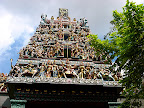
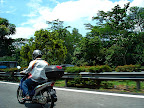
After an hour there we jumped in a taxi to the world renowned Singapore Zoo. Apart from the road to the airport, it was the first time I'd seen outside the city. Residential areas turned surprisingly quickly into dense jungle, which was parted by the clean, modern highway.
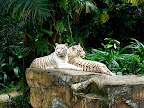
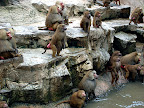
The zoo is built on a peninsula, and houses animals from all over the world, including polar bears! Highlights were the amazing rare white tigers and the dozens of crazy red-arsed baboons (possibly not the scientific name). Check out the rest of the photos for more.
Just as the three-thirty elephant show began, it started to rain. It steadily got heavier, until it was a full-on tropical downpour, and they had to call off the show. We were stuck at the elephant enclosure for an hour, although the elephants themselves didn't seem bothered as they played in the mud. As soon as we'd resigned to getting soaked, some guy came around selling plastic ponchos for two dollars. Genius.
We wandered around for another hour in the storm but most of the animals had been moved under shelter (as if cheetahs can't handle a little rain). The only ones left out were the hippos, giraffes and the polar bear, who was probably enjoying the relief from the heat. For those wondering, they keep him in a deep chilled pool and he has an air-conditioned cave, although he was actually born at the zoo. It was a bit of a disappointing end to the afternoon, since we missed a lot of animals like the big cats.
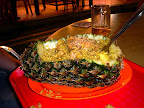
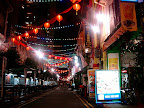
After catching a bus and train home, we spent a few hours in the hotel business club, and then walked over to Chinatown later that night for food. The Smith St food market was just closing up but we got a meal of fried rice inside a hollowed out pineapple plus a few cheap beers. I would have liked to explore more if we'd had time.
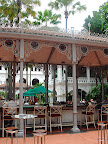
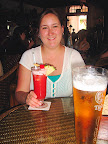
The next day was Easter Sunday and we only had a half-day before our flight home at 6pm. After a quick shopping expedition to Orchard Road, we headed back into the city to the famous Long Bar at Raffles Hotel, where the Singapore Sling was invented. Claire had the cocktail while I had a Tiger, which came to $45 (!) but I guess you've got to do it once.
On returning to the hotel just after lunch time, we packed and checked out in record time, took a quick taxi to the airport. Again, we didn't get much shuteye on the trip back, but the 8am arrival was timed well so that we had all of Monday to catch up on sleep.
It was such a short holiday it's still hard to believe it all happened, although I'm sure it was slightly more memorable than the original weekend in Newcastle would have been (sorry Novocastrians).